




This package is a forward simulator designed to generate synthetic metacommunity data. As an in silico experimental platform, it enables researchers to computationally generate hypothetical community shifts, test theoretical frameworks and benchmark analytical algorithms prior to empirical application.
Core capabilities include:
terra ecosystem, the package reads and writes standard
spatial formats (such as GeoTIFFs and ESRI grids), allowing simulations
to run across dynamic environments.You can install mrangr with:
install.packages("mrangr")The mrangr workflow involves initialising a community
with spatial data and interaction parameters, running the simulation,
and analysing the results.
You must provide carrying capacity maps (K_map) and
initial abundance maps (n1_map) as SpatRaster
objects. For a community of \(N\)
species, the rasters must contain \(N\)
layers.
# Load example maps
K_map <- rast(system.file("input_maps/K_map_eg.tif", package = "mrangr"))
K_map <- subset(K_map, 1:2)
Interspecific interactions are defined using an interaction matrix (\(a\)), where values represent the per-capita interaction strength of the species in the column on the species in the row.
# Example for 2 species with symmetric competition
nspec <- 2
a <- matrix(c(NA, -0.8, -0.8, NA), nrow = nspec, ncol = nspec)Use initialise_com() to create a
sim_com_data object. This stores all parameters, including
the intrinsic growth rate (\(r\)) and
the dispersal rate.
first_com <- initialise_com(
  n1_map = round(K_map / 2),
  K_map = K_map,
  r = 1.1,
  a = a,
  rate = 1 / 500
)The sim_com() function executes the simulation over a
specified number of time steps.
first_sim <- sim_com(first_com, time = 100)You can visualise the final spatial distributions or the change in mean abundance over time.
# Visualise spatial niches at specific time steps
plot(first_sim, time = c(1, 10, 100))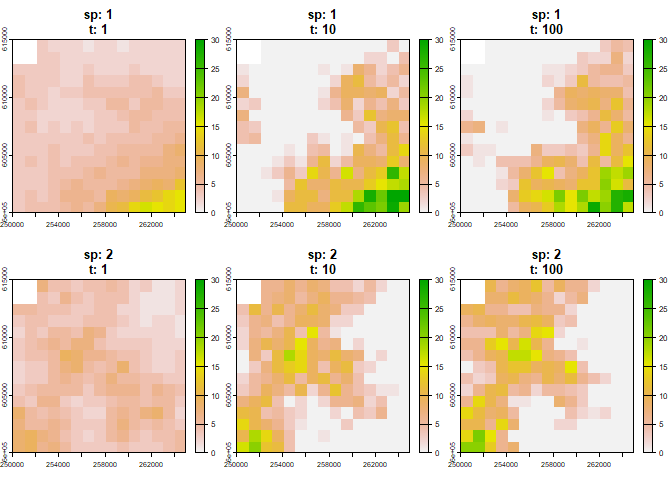
# Plot abundance time series for all species
plot_series(first_sim)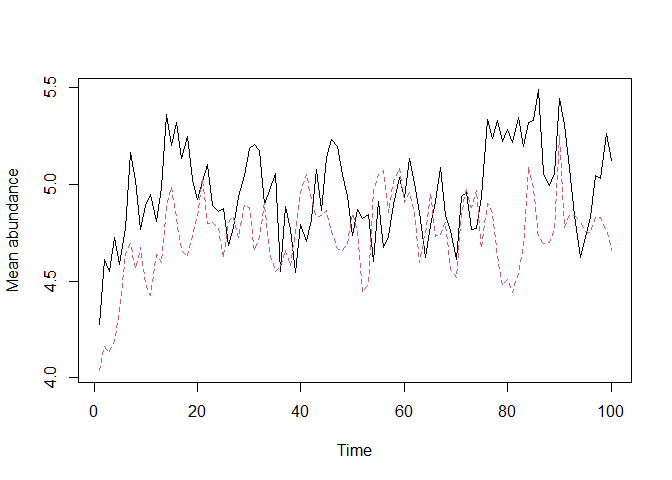
The package includes a virtual_ecologist() function to
simulate real-world observation processes. This allows users to sample
the simulated community at defined points in space and time,
incorporating sampling effort and detection probability into the
simulation.
To cite mrangr, please use the
citation() function:
library(mrangr)
citation("mrangr")This work was supported by the National Science Centre, Poland, grant no. 2018/29/B/NZ8/00066 and the Poznań Supercomputing and Networking Centre (grant no. pl0090-01).